
By Bruce D. Smith, CFA®
When buying a TV, price is generally the key consideration. If Best Buy is selling the model you want for $1,200 and Amazon has exactly the same product for $1,000, it makes sense to spend less on the TV and get it from Amazon.
In contrast, when a credit union is considering a split dollar Supplemental Executive Retirement Plan (SERP), price cannot be the main purchasing factor because the life insurance products supporting it are very different. Instead, it’s important to look very carefully at the type of life insurance being proposed and the risks associated with it.
In the credit union space, a split dollar plan can be set up based either on whole life insurance or indexed universal life (IUL) insurance. These insurance products are not interchangeable like TVs or computers, making it imperative to understand each product before making a decision.
Split dollar plans based on IULs always appear less expensive than whole life-based split dollar plans. As highlighted in great detail in our white paper, Why Indexed Universal Life Is Attractive (and Detrimental) for Executive Retirement Plans, IULs illustrate aggressive return assumptions to get the sale, unless forcibly illustrating conservatively, history has shown they don’t perform even close to those initial assumptions.
This contrasts significantly with split dollar plans based on whole life insurance, which are designed using conservative and historically tested assumptions that go back more than a century. The natural conservatism of whole life using reasonable, defensible return assumptions results in a much more durable split dollar plan. Using conservative return assumptions always requires a larger plan loan. By definition, the more aggressive assumptions require less money because you’re assuming a much higher rate of return. Conversely, conservative assumptions always require more money.
If you’re getting a higher rate of return, you’re assuming more risk. If you’re committing less for the “same” split dollar solution, you’re assuming more risk.
From an executive’s viewpoint, it’s important to ask yourself how much risk you want in your retirement plan—the plan that will help you fund your future lifestyle.
This article will help you and your credit union avoid getting “bargainized.” We don’t want you to buy a “less expensive” split dollar plan only to find out that the significant risk and over-aggressive assumptions in that IUL-based plan keep it from delivering the expected benefit.
The math readily shows that IUL-based split dollar plans will underperform their initial assumptions half of the time. Half!
Moreover, the math shows that IUL-based split dollar plans will deliver significantly less return than what was originally projected 25% of the time.
Hard to believe? It won’t be if you think about the math.
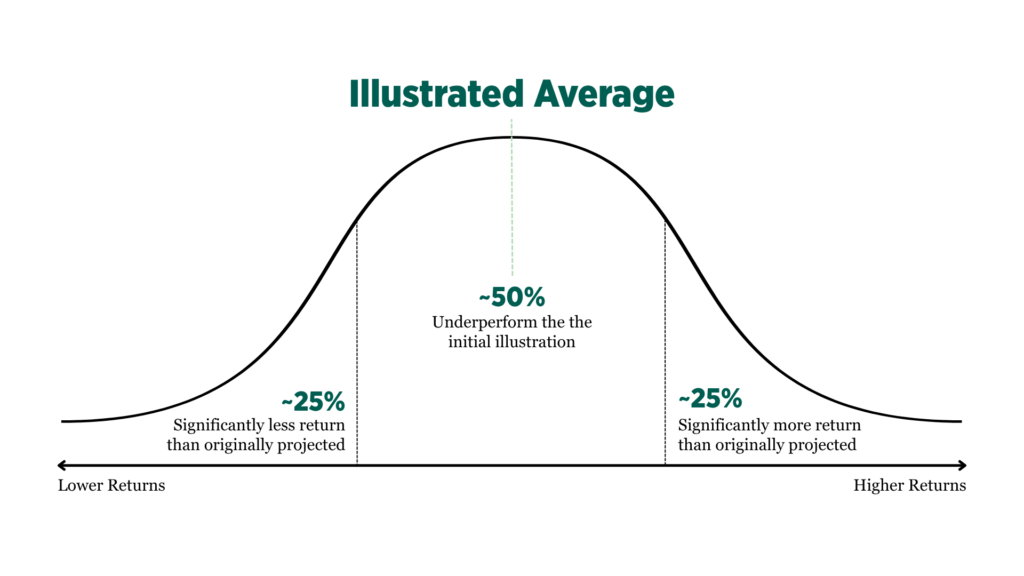
To compute the “illustration” of how your IUL-based plan is expected to perform, insurance companies average the outcomes of 25-year time blocks of policies going back 66 years (more on this here.) This average, like all averages, creates a “bell curve” that shows how values in the dataset are distributed, with most falling near the average and fewer appearing at the extremes.
Your IUL plan will deliver as illustrated if the math puts it near the illustrated average. It could also fail to deliver on the illustration if the actual performance of the plan falls at or near the extremes of the curve. Get more on the math for credit union SERPs in our other in-depth white paper.
There’s good news here. You have another choice for setting up your SERP with much more opportunity for success: whole life insurance. The inherent conservatism of whole life, which this article will detail, makes it the right choice for a credit union’s split dollar plan, especially when purchased from a mutual insurance company.
Five Characteristics of Whole Life Insurance from a Mutual Insurance Company That Make It the Right Choice for Split Dollar Plans
We often speak with executives whose IUL-based split dollar plans aren’t set up to manage risk effectively, and it’s concerning because their plans are more likely to fail to deliver the hoped-for retirement benefit than plans based on whole life. The issues with using IULs are well known. Websites inviting people with bad IUL experiences to connect with attorneys are proliferating, and many lawsuits are being filed.
At PARC, we only implement split dollar plans based on the significantly more conservative whole life insurance product from mutual insurance companies. Mutual insurance companies whose primary business is whole life have very long time horizons.
What gives us real confidence in the success of our plans is that there is no daylight between management and these companies’ whole life policyholders. They are run solely for the benefit of their whole life policyholders.
Here are more reasons why you need to implement your split dollar plan using whole life insurance from a mutual insurance company that has whole life as its primary business:
1. You Become an Owner

When you buy a whole life insurance policy from a mutual company, you become an owner of that company and share in its profitability.
The profit a mutual insurance company makes is based on its expenses, mortality experience, and investment earnings. The insurance company chooses both how much profit to pay out to policyholders through dividends1 and how much to reinvest in other business lines that throw off long-term profits to benefit policyholders.
PARC primarily works with MassMutual, founded in 1851, and New York Life, founded in 1841, because of these mutual companies’ long track record of success.
While whole life dividends are not guaranteed, whole life insurance has a long history of consistently paying dividends. MassMutual has paid dividends since 1869 and New York Life since 1854, having successfully done business through the Civil War, the Great Depression, world wars, and financial crises without missing a beat.
Four key factors drive any dividend shared with whole life policyholders:

The premium payments made on the products a mutual insurance company sells are initially invested through the company’s general account. The general account is conservatively managed, with the majority of funds invested in fixed-income securities. Because of this, interest rates are a critical factor for the profitability of an insurance company. The decline in rates we experienced over the last 40 years put downward pressure on the profitability of these insurance companies, resulting in a decline in the dividend. The rise in interest rates that started in the spring of 2022 is now benefiting all whole life policyholders of mutual insurance companies like MassMutual and New York Life.
All mutual whole life insurance policyholders are generally treated the same; contrast that with IUL policyholders not being treated equally.2
As an example, most insurance companies have de-linked their IUL policies into separate closed blocks, each with a different cap. Because of this separation, the rise in rates since 2022 has a very small benefit to policies in the older closed blocks. Moreover, a leading expert on IULs, Bill Boersma, posits that an insurance company has no financial incentive to ever share the rise in rates with its closed blocks. All of this creates a permanent disadvantage for older blocks, rendering them unable to achieve their original goals. We believe this pattern will continue, and that the current open block will be closed at some point. When that happens, policyholders in that block will no longer be able to share in the advantages available to those in newer blocks. If this scenario plays out as we expect, you’re better off as a prospect than as a client!

The 40 years of declining interest rates prior to 2022 led forward-thinking mutual insurance companies, like MassMutual and New York Life, to diversify into highly complementary outside businesses. For example, MassMutual has diversified with Barings, a global institutional investment management firm with expertise in fixed income, real estate, and specialist equity markets consulting; Rothesay, the largest specialty annuity provider in the United Kingdom; MassMutual Ascend, a leader in the fixed and indexed annuity market; and others. New York Life has diversified with New York Life Investment Management, one of the world’s largest active asset managers, which provides tailored institutional equity, fixed income, and alternative strategies for large-scale investors; New York Life Group Benefit Solutions, a major provider of corporate employee benefits offering employer-sponsored life, accident, disability, and voluntary insurance products; non-participating insurance & annuities; and others.
Mutual insurance companies either own these complementary businesses outright or have large equity stakes. These outside investments are managed similarly to the overall insurance company, with very long-term investment horizons.
The benefit to policyholders is that the profitability of these outside investments flows up to the parent company and is then shared with policyholders through the dividend. This is similar to credit unions’ use of CUSOs (credit union service organizations) to support their core business and better serve their members with complementary services.3

Another important factor in the profitability of mutual life insurance companies supporting the stability of whole life dividends is that people are living longer. When people live longer, whole life insurance policies are more profitable. Based on continued medical advancements, life expectancy in the United States is projected to keep going up, a trend that will act as a tailwind to the profitability of mutual life insurance companies, supporting the dividend in the long term.

As with any business, managing expenses well contributes to the profitability of a mutual insurance company.
All of this is foundational to the conservatism of whole life and its profitability, and, ultimately, why it is the right product to choose for executive retirement plans.
2. Mutual Insurance Companies and Credit Unions Have a Similar Customer/Member Service Outlook
As we’ve said, there is no daylight between the decisions management makes at a mutual insurance company and what is in the long-term interest of the policyholders. This parallels how credit unions focus on serving their members, whereas banks ultimately serve their shareholders.
Roger Crandall, chairman, president, and CEO of MassMutual, underscored the value of mutuality in a 2022 McKinsey podcast:
“Because this is such a long-term business, having one set of stakeholders, our policyholder customers, to drive us is a huge advantage. We get to think about a long-term business in a long-term way. We never have to wonder, ‘Should we invest in something that would have a longer-term payoff, or should we respond to an equity holder’s shorter-term time horizon?’
“Our publicly listed peers have to respond to their shareholder demands, for good reason. And when we talk to customers, they understand that they are the company, which is interesting in a world of social media where people want companies they do business with to align with their values and purpose.”
In his introduction to the company’s 2024 report to policyholders, Craig DeSanto, chair, president, and CEO of New York Life, said it clearly: “As a mutual company, New York Life has a singular mission: serving you.”
None of the benefits we’ve described in points 1 and 2 are conferred to IUL policyholders. IUL policyholders benefit only from performance based on the cap and the floor, which is driven by the investment yield the company chooses to spend on options. And as we’ve already mentioned, almost all IUL policyholders are treated differently from one another based on when they purchased their policy. Our in-depth white paper, Why Indexed Universal Life Is Attractive (and Detrimental) for Executive Retirement Plans, explains this in detail.
3. Long-Term Data Shows That Dividends4 From Whole Life Insurance Policies Pay Steadily and Only Fluctuate a Small Amount Each Year
Over the last decade, the dividends on whole life insurance at the major mutual insurance companies have increased 3.5%.5 They have also fluctuated very little year to year. For MassMutual over the last 25 years, the average dividend increase has been 25 basis points (0.25%), and the average decrease has been 31 basis points (-0.31%).
The consistency of whole life dividends over the last 150-plus years makes it possible to much more effectively project the performance of whole life insurance when you set up your split dollar plan that can’t be done for IUL. Remember, these are always projections. Everything changes after you implement the plan. Consistency matters.
The more consistent whole life dividends allow us to design your split dollar plan with the right amount of downside protection for potential declines in the dividend. The relative stability of whole life dividends also makes it easier to monitor your plan over time and determine whether it continues to be on track to perform as desired at retirement.
In contrast to the increase in whole life dividends over the last 10 years, the caps that determine the return on IUL policies have declined about 40% in the same timeframe. Interest rates impact dividends and caps. But since all policyholders of whole life insurance from a mutual insurance company are treated equally, they are benefiting in the same way from the rise in interest rates over the last three years. That is not the case for IUL policyholders.

IUL policies also face the inherent challenge of sequence of returns risk, which, in simple terms, means that the timing of withdrawals has a significant impact on whether or not the plan succeeds in delivering the originally illustrated benefit at retirement. Conversely, the stability of whole life dividends results in the sequence of returns risk not being a factor for whole life policies. See our in-depth white paper for more details.
4. Whole Life Insurance Has Many Guaranteed Elements
The guaranteed elements of a whole life insurance policy are foundational: the premium, death benefit, and cash value accumulation, so long as premiums are paid. The dividend is what drives the overall performance of the plan by increasing the death benefit and cash value.
In terms of who bears the policy risk, whole life from a mutual insurance company is fundamentally different from IUL insurance. With IULs, the insurance company is shifting the risk to policyholders. In contrast, when utilizing whole life insurance from a mutual insurance company for a split dollar plan, the buyer is making an investment in that company. And the mutual insurers we use have a long history of managing the risk of whole life insurance extremely well.
5. While IULs Are Designed To Illustrate Well, Whole Life Is Designed To Work
An “illustration” is what a split dollar plan provider shows you upfront about how a particular plan might perform. The assumption of how well a plan will perform determines how much you have to invest to set up the plan. If the assumption about plan performance is too aggressive, the price tag, or total premium, is lower, but the potential for the plan to fail to deliver the original projected benefit is significantly higher.
Illustrations for whole life insurance-based split dollar plans are conservative. By regulation, they can’t assume a higher dividend than the current dividend. Additionally, at PARC we often design plans below the current dividend to build in downside protection and make the plan even more resilient.
The lower illustrated return on a whole life split dollar plan might mean the credit union needs a loan for $7 million instead of $5 million to set up the plan initially, but we think that’s worth it for a plan designed to protect both the executive and the credit union.
In contrast, careful analysis of IUL illustrations finds that they are far too aggressive. To evaluate illustrations of IUL-based split dollar plans as they relate to actual performance, PARC utilizes sophisticated Monte Carlo-like simulations that incorporate sequence of returns risk.
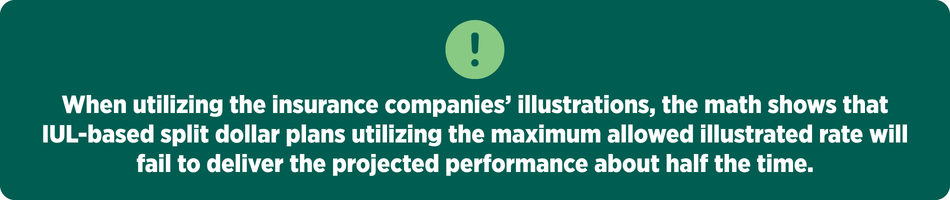
As we’ve said before, when utilizing the insurance companies’ illustrations, the math shows that IUL-based split dollar plans utilizing the maximum allowed illustrated rate will fail to deliver the projected performance about half the time. And it’s much worse when incorporating sequence of returns risk. This is a fundamental flaw when illustrating an IUL split dollar plan. IUL split dollar plans are designed to promise a lower up-front cost due to the aggressive return assumptions. Once again, 25% of the time, the retirement benefit from an IUL-based split dollar plan will be significantly less than originally illustrated.6
As we pointed out in the introduction to this article, a credit union can’t buy a split dollar plan based on price like consumers do when buying a TV. In the case of an IUL-based split dollar plan, a credit union could invest $5 million and not get the executive the retirement benefit they expected.
Whole Life Is Conservative, and Therefore the Right Choice for Split Dollar Plans
Bobby Samuelson, executive editor of The Life Product Review, the industry’s best source for independent and objective life insurance product intelligence, has long expressed his concern about using IULs for retirement plans. To quote Bobby in our conversation with him, “The problem with IUL is not the product. It’s not the companies that sell the product. It’s not even the option strategy underlying this product. All that stuff does what it’s supposed to do. The issue is when you come into these products with improper expectations.
“The default illustration was created by life insurance companies to sell more IUL. That [selling more IUL] is not the goal of a credit union. The goal of the credit union and an executive at a credit union is to have value at the end of the transaction, and that is a completely different goal. And so, therefore, you should illustrate it completely differently.”
For executives and board members looking at split dollar plans, the message is clear: If you want to show realistic returns that will reliably work, you have to illustrate conservatively for IUL and whole life. Whole life does it out of the box. You have to force IUL to do it, and by the time you’re done doing that, IUL loses its appeal.
Why We Sleep at Night
At PARC, we are driven to make sure every split dollar plan we implement works for both the executive and the credit union. That’s why we never stop talking about the significant and critical differences between IUL and whole life. In addition to educating executives and board members, we constantly study plan design, collect data on credit union SERPs, and track the larger market context—then put that knowledge into practice every single day. We live our commitment to the people we serve.
That commitment is why every split dollar plan PARC has implemented since September 2014 is currently on track to deliver on, or exceed, its original projected benefit.7 We would find any other situation unacceptable. We are highly confident that nobody else doing credit union SERPs can say the same thing about their split dollar plans implemented in the same timeframe.
If you are an executive with an IUL who has already received bad news telling you that your plan will fall short, or if you’d like help sorting through your split dollar SERP options, please reach out.
CRN202909-12103055
About the Author

BRUCE D. SMITH, CFA®
Partner & Senior Benefits Consultant
Bruce D. Smith, CFA®, oversees PARC Street Group’s integrated leadership services alongside Christopher J. Jones, ChFC®, CLU®. In his role, Bruce partners directly with credit unions to design and implement Supplemental Executive Retirement Plans (split dollar plans) that are durable, compliant, and built to perform over the long term. With more than four decades of financial services experience, he combines deep technical expertise in plan design with a client-first approach, ensuring that executives and boards can move forward with clarity and confidence.